Lusha vs Readymode
Lusha and Readymode solve very different problems. Lusha finds contact data, while Readymode makes the calls. One is a data source; the other is a full dialing platform.
Best for: Sales teams needing to build fresh prospect lists from a verified B2B database., Recruiters sourcing candidates and needing accurate contact info.
Best for: Outbound sales teams in industries like real estate, solar, or insurance., Lead generation companies needing efficient contact and qualification.
Serious questions about data privacy.
We observed extreme user concerns regarding Lusha’s data sourcing and privacy adherence, particularly concerning the alleged sharing of scraped personal contact numbers, which overshadows any intended utility. Overall, we cannot recommend a service facing such severe ethical and contractual complaints from its user base.
Pros
- Offers a generous Free plan to test basic functionality.
- Provides broad API and CRM integration options.
- Can be effective for prospecting when the data is accurate.
Cons
- Major concerns regarding the ethical sourcing and sharing of private contact data.
- Users struggle to opt-out or remove their personal information (GDPR violations alleged).
- Substantial complaints about high inaccuracy and obsolete contact details sold.
- Aggressive auto-renewal policies and opaque contract cancellation terms.
Powerful outbound dialer, but premium priced.
We see Readymode as a comprehensive solution for outbound sales teams needing a predictive dialer and built-in CRM. The platform excels at boosting productivity and ensuring compliance. Overall, it's a strong choice for mid-sized teams, but the higher price point may give smaller operations pause.
Pros
- Intuitive, user-friendly interface for agents.
- Strong built-in compliance features (TCPA, DNC).
- Effective predictive dialer boosts talk time.
- Responsive and helpful customer support.
Cons
- Higher cost, especially for the iQ tier.
- No free trial available for evaluation.
- Pricing details are not fully public upfront.
- Some users report occasional call reliability issues.
AboutLusha
Lusha powers up your entire Go-To-Market (GTM) engine. It provides access to a massive database of over 280 million verified B2B contacts, helping teams reach precise decision makers. Professionals across Sales, RevOps, Marketing, and Recruiting use Lusha to streamline their work and maximize return. 💡
For sales teams, Lusha helps the pipeline grow with live leads and faster closes. RevOps benefits by keeping data stacks clean, compliant, and connected for better ROI. Marketers power campaigns with enriched audiences, and Recruiters quickly find top talent using highly accurate contact data. This tool truly helps you scale up your business using trusted data.
AboutReadymode
Readymode is a hybrid-cloud call center software optimized for outbound sales and lead generation. It’s built for businesses that need to connect with high volumes of leads efficiently. 📞 The platform blends outbound and inbound calling, so your sales and support teams can work seamlessly from one place.
Highlights
Feature Comparison
Features Overview
We highlight the main differences and pick a winner for each feature.
Core Purpose
Lusha provides contact data. Readymode makes the calls. They solve different parts of the sales puzzle.
Lusha is a B2B data provider. Its job is to give you accurate emails and phone numbers for prospects. You use its AI and database to build lists. Readymode is a calling platform. It takes your existing leads and helps your team call them efficiently. It's a dialer, CRM, and compliance tool in one. The key difference is intent. Use Lusha to find people to call. Use Readymode to actually call them. They could even work together in a sales stack. Think of it like fishing. Lusha helps you find the fish. Readymode is the boat and net you use to catch them.
Contact Data Quality
Lusha guarantees data accuracy. Readymode uses whatever data you provide.
Lusha focuses on providing verified B2B data. It claims 85% accuracy for phone numbers and 98% deliverability for emails. This is its core value. Readymode doesn't provide contact data. It's a tool for calling lists you already have. The quality of your calls depends on the quality of your imported leads. The trade-off is clear. With Lusha, you pay for fresh data. With Readymode, you bring your own data and pay for the tools to use it effectively. If your main problem is bad contact info, Lusha is the answer. If your problem is inefficient calling, Readymode is the solution.
Calling & Dialing
Readymode has a smart predictive dialer. Lusha doesn't make calls.
Lusha's features end at providing contact info. It has no dialer or calling functionality. You export its data to use elsewhere. Readymode's predictive dialer is its star feature. It automatically adjusts speed, blends inbound/outbound calls, and maximizes agent talk time. It handles the entire calling process. This is the biggest functional gap. Readymode is an execution engine. Lusha is a data engine. You need both for a complete outbound process, but they aren't direct competitors. For teams that live and die by call volume, Readymode's dialer is essential. Lusha is useless for the actual calling work.
Compliance & Risk
Readymode has built-in compliance tools. Lusha faces major data ethics concerns.
Readymode includes rules for TCPA, DNC lists, and state calling restrictions. It records calls for QA and compliance. This reduces legal risk for calling teams. Lusha has serious compliance issues. Users report scraping private data and violating GDPR. Trustpilot reviews are filled with complaints about unwanted calls and ignored deletion requests. The contrast is stark. Readymode helps you stay compliant while calling. Lusha's own practices are called into question by its users. For businesses worried about lawsuits and reputation, Readymode's built-in tools are a major advantage. Lusha's ethical issues are a red flag.
User Experience & Support
Readymode users praise its ease of use. Lusha users report unresponsive support.
Readymode reviews highlight its intuitive interface. New agents get up to speed quickly. Support is described as responsive and helpful. Lusha reviews are overwhelmingly negative. Users complain about inaccurate data, aggressive billing, and impossible-to-reach support. Many feel scammed. The user sentiment tells a clear story. Readymode delivers a functional product with good support. Lusha fails on data quality and customer service. When your team's daily tool causes frustration (like Lusha for many), productivity suffers. Readymode seems to avoid this trap.
Integration Ecosystem
Both integrate with major CRMs. Lusha offers more API flexibility.
Lusha connects with Salesforce, HubSpot, Outreach, and Slack. It offers API and MCP integrations for custom workflows with tools like Zapier. Readymode's iQ plan includes unlimited integrations. The Starter plan's integration capabilities are less clear. It focuses on connecting with your existing sales stack. Lusha gives you more raw data to push into other systems via API. Readymode focuses on pulling data from your CRM into its calling environment. For RevOps teams building custom pipelines, Lusha's API might be more flexible. For sales teams needing a closed-loop calling system, Readymode's integrations are purpose-built.
Pricing & Value
Lusha has a free plan but a confusing credit system. Readymode is expensive but transparent.
Lusha offers a free plan with 70 credits/month. Paid plans are customized via sales. The credit system (1 for email, 10 for phone) can be confusing and expensive at scale. Readymode has clear pricing: $199-$249 per user/month. No free trial. You know the cost upfront, but it's a significant per-seat investment. Lusha's value depends entirely on how many contacts you need to find each month. Readymode's value depends on how many calls your team makes. A solo prospector might love Lusha's free tier. A 10-person sales team will find Readymode's monthly bill predictable, albeit high.
Lusha offers plans starting at Free, with paid plans requiring contact for pricing details.
Details for specific pricing tiers were unavailable due to a technical error on the Lusha website itself, but we can review the featured plans based on the available text.
Free plan
Price: Free Best For: Getting started with B2B prospecting Refund Policy: Not applicable Other Features:
- Up to 70 credits per month
- Access to basic prospecting features
- Browser extension
- CRM integrations
- Up to 70 credits per month
- Basic prospecting features
- Browser extension
- CRM integrations
- Fully customizable
- Ability to limit credit usage per user
- Includes annual credit rollover option
- Designed for teams larger than 5 users
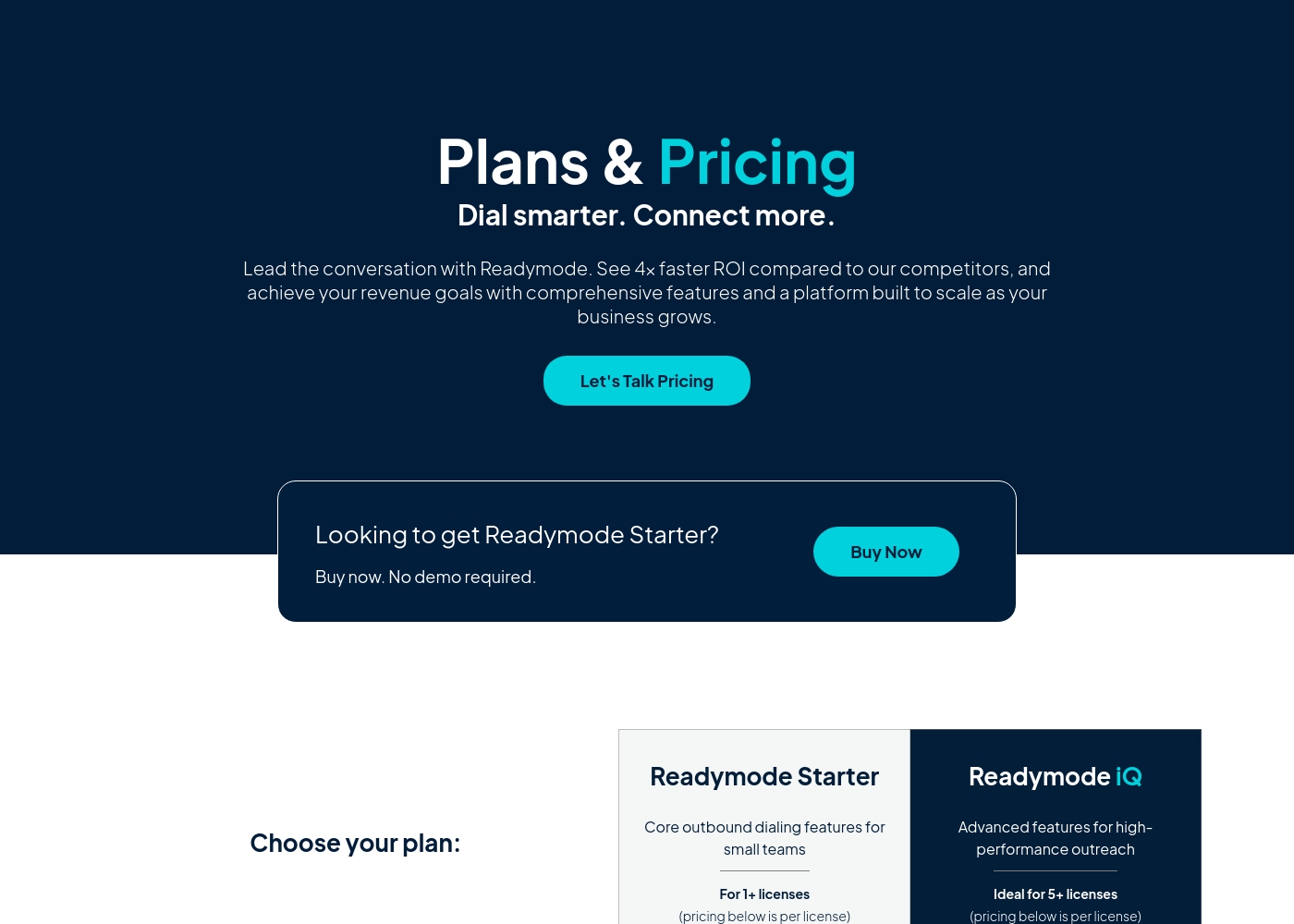
Readymode costs between $199 and $249 per month with 2 plans: Readymode Starter at $199, and Readymode iQ at $249.
Take a look at the details below to find the right fit for your sales team.
Readymode Starter
Price: $199 USD per license/month Best For: Individuals and small teams Other Features: 30 DIDs included, free outbound minutes, 24/7 unlimited support, waived set-up fees, and built-in vertical CRM.
- 30 Phone numbers (DIDs)/license
- Unlimited Support
- Free Outbound Minutes
- Waived Set-Up Fee
- Built-in CRM
- 75 Phone numbers (DIDs)/license
- DID Reputation Monitoring
- Autopilot & Call Cadencing
- Unlimited Integrations
- Early Access to New Features
Pricing Notes
- Lusha's free plan is its only self-serve option. Paid plans require contacting sales, making pricing opaque.
- Readymode has no free trial or free plan. You must request a demo and commit to a paid license.
- Lusha's credit system can lead to unpredictable costs if your team reveals many phone numbers (10 credits each).
- Readymode's $199-$249/user/month is a high upfront cost but includes unlimited outbound minutes (fair use).
- Both platforms use auto-renewal, but Lusha's billing practices are a common complaint in user reviews.
Pricing Head-to-Head
User Reviews
User feedback concerning Lusha is overwhelmingly negative, centering on severe data ethics and privacy violations. Many reviewers allege Lusha scrapes and distributes personal contact information—including private mobile numbers—without user consent, leading to a huge volume of unsolicited calls and spam.
Users feel this is a "scammy" or "spam-enabling" practice that violates GDPR. A major complaint is the difficulty in getting personal details removed; many requests for data deletion are reportedly ignored, or the information reappears soon after.
I keep receiving daily unsolicited calls to my personal phone number. When I ask where they got my details, they consistently cite Lusha. This company shows a blatant disregard for privacy.
We found that external reviews for Readymode are mixed but largely positive. Many users praise its ease of use, highlighting the intuitive interface and how quickly new agents can get up to speed.
Support responsiveness is another frequently mentioned strength, with users reporting helpful and accessible customer service. However, pricing and value are common points of contention, with some feeling the cost is high, especially for smaller teams.
The platform is incredibly intuitive, and our team was up and running quickly. The predictive dialer has been a game-changer for our contact rates.
Our Verdict
Lusha and Readymode aren't competitors—they're two pieces of a sales puzzle. Choosing between them is like choosing between a map and a car. You need both for a journey, but they do completely different things. Lusha's superpower is its massive B2B database. It uses AI to build prospect lists and guarantees 85% phone accuracy. It's designed to feed your pipeline with contact data. Readymode's superpower is execution. Its predictive dialer, built-in CRM, and compliance tools turn those leads into conversations. It's built to maximize agent talk time and reduce risk. The deciding factor is your biggest pain point. Is it finding accurate contact information? Lusha is your answer. Is it making those calls efficiently and compliantly? Readymode is built for that job. For most outbound teams, the logical path is to use both. Use Lusha (or a similar service) to source the data. Then, use Readymode to call that data intelligently. If you can only choose one right now, pick Readymode if you have leads to call, or Lusha if you're still building your list.
Frequently Asked Questions
Which is better for small teams: Lusha or Readymode?
It depends on your role. A solo prospector might start with Lusha's free plan. A small sales team making regular calls needs Readymode's dialer, even at $199/user/month.
Can I use Lusha and Readymode together?
Yes, they complement each other well. You could use Lusha to find contact data, then import those leads into Readymode to make calls.
Is Readymode worth the extra cost over Lusha?
They aren't priced against each other. Lusha is for data. Readymode is for calling. Readymode is worth it if you need a predictive dialer and compliance tools for a calling team.
Does Lusha have a predictive dialer like Readymode?
No, Lusha is a data provider. It does not include any calling or dialing functionality. Readymode's predictive dialer is a core feature.
Which tool has better customer support?
Readymode users consistently praise its support. Lusha users report unresponsive or non-existent support, even for paying customers.
Which is better for compliance and data privacy?
Readymode wins here. It has built-in TCPA and DNC compliance tools. Lusha faces major user complaints about unethical data sourcing and violating privacy.
Ready to Choose?
Both tools have their strengths. Choose based on your specific needs.