Pangram Labs vs Sapling
Choosing between Pangram Labs and Sapling isn't easy. Both claim to detect AI writing, but they deliver very different experiences. One is a precision instrument, the other a writing assistant with a detector bolted on.
Best for: University professors and academic institutions, Publishers vetting articles for originality
Best for: Solo writers and bloggers, SEO professionals needing quick grammar checks
Highly accurate, but limited external validation.
We find Pangram Labs to be a technically impressive AI detector with verified accuracy claims and excellent LMS integrations. However, our review is based solely on provided company materials, as external review platforms were inaccessible. Overall, the product's feature set appears robust for its target audience.
Pros
- Industry-leading 99.98% accuracy claim verified by universities
- Very low false positive rate (1 in 10,000)
- Seamless integrations with Google Classroom, Canvas, and Moodle
- Detects all major AI models and AI-assisted writing tools
Cons
- No accessible external user reviews to validate claims
- Pricing is credit-based, which may require monitoring usage
- Advanced features like API access require additional payment tiers
- LMS integration details (e.g., depth of reporting) not fully specified
Powerful Writing Assistant, Unreliable Detector.
We found Sapling offers powerful tools for improving grammar and making written text more concise, features that users often praise above competitors. Overall, the reported serious issues regarding the AI content detector's high false positive rate significantly undermine confidence in its primary specialized function.
Pros
- Offers significant savings with an annual discounted Pro plan ($12/month).
- Writing suggestions frequently cited as superior to Grammarly for corrections.
- High claimed detection accuracy (97%) for longer AI-generated texts.
- Identifies and highlights sentence segments indicative of simplistic phrasing.
Cons
- AI detector frequently reports significant false positives on human-written content.
- Citations of rigid or inconsistent detection results.
- Reports of high memory usage specifically for the browser extension.
- Interface described by some users as clunky.
AboutPangram Labs
💡 Pangram is an AI content detector and plagiarism checker. It's designed for educators, universities, publishers, and enterprises who need to verify the authenticity of written text. The tool analyzes submissions to determine if they are human-written, AI-generated, or AI-assisted, helping maintain integrity in various fields.
AboutSapling
The Sapling AI Content Detector is a powerful tool designed to check the probability that text was written by models such as ChatGPT or Gemini. It uses a specialized machine learning system—a Transformer—to analyze the input. This system specifically estimates the probability that each word or token is machine-generated. 💡
This utility is especially useful for educators concerned about learning integrity, or for practitioners reviewing large volumes of synthetic content. You're guided by visual results, seeing both the overall text score and highlighted portions. The detector also flags individual sentences with low perplexity, helping you catch simplistic or cliché phrasing.
Highlights
Feature Comparison
Features Overview
We highlight the main differences and pick a winner for each feature.
AI Detection Accuracy
Pangram Labs boasts near-perfect accuracy. Sapling claims excellent performance but struggles with false positives.
Pangram Labs delivers 99.98% accuracy, verified by the University of Chicago and Maryland. Its false positive rate is just 1 in 10,000. This makes it exceptionally reliable for high-stakes decisions.\n\nSapling claims over 97% detection for longer texts. However, numerous user reviews report frequent false positives on human-written content. This inconsistency undermines trust in its core detection function.\n\nThe key trade-off is verifiable precision versus unverified claims. Pangram Labs provides proven reliability, while Sapling's results can be unpredictable.\n\nFor an educator grading hundreds of papers, Pangram Labs eliminates the risk of wrongly accusing a student. Sapling's potential errors could damage trust.
Core Functionality & Focus
Pangram Labs is a dedicated detection tool. Sapling is a writing assistant with detection features added on.
Pangram Labs focuses solely on AI detection and plagiarism checking. It's built from the ground up for this single purpose. The entire tool is optimized for accuracy and verification.\n\nSapling started as a writing assistant, like Grammarly, and later added an AI detector. Its core strength remains grammar and style suggestions. The detector is a secondary feature.\n\nThis difference in focus leads to different user experiences. Pangram Labs feels like a specialized lab instrument. Sapling feels like a multi-purpose toolkit.\n\nA content manager needing quick, reliable AI checks will prefer Pangram Labs. A writer wanting both proofreading and occasional AI checks might prefer Sapling.
Integration Ecosystem
Pangram Labs integrates into learning platforms. Sapling integrates into your writing flow.
Pangram Labs connects directly to LMS platforms like Canvas, Moodle, and Google Classroom. This allows teachers to scan submissions without leaving their workflow. It's built for institutional use.\n\nSapling offers browser extensions for Chrome, Outlook, and Word. This lets you check text anywhere you type online. It's built for individual writers and content creators.\n\nPangram Labs' integrations are deep but narrow. Sapling's integrations are broad but shallow. One is for verification within a system; the other is for assistance everywhere.\n\nA university IT department would choose Pangram Labs for campus-wide deployment. A freelance writer would choose Sapling for everyday editing.
Pricing & Value
Pangram Labs has tiered pricing based on usage. Sapling has simple plans but a confusing annual discount.
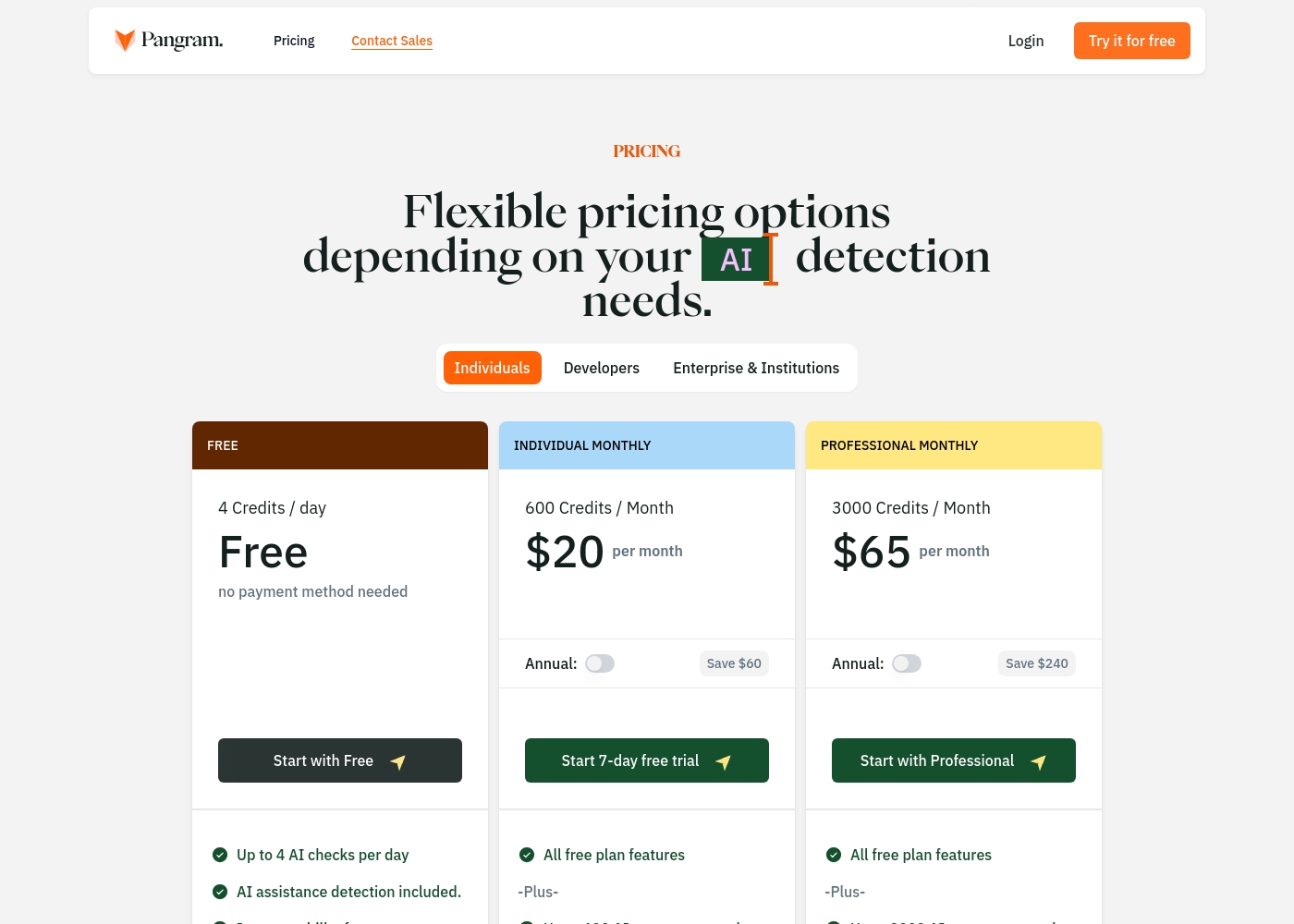
Pangram Labs ranges from a free plan (4 checks/day) to $65/month for 3,000 credits. Pricing is transparent and tied directly to scanning volume. You pay for what you use.\n\nSapling's Pro plan is $25/month, but drops to $12/month if you pay annually. This creates confusion about the real monthly cost. The Enterprise plan is $15/seat/month with a 10-seat minimum.\n\nPangram Labs offers more predictable value for teams. Sapling offers a cheaper path for individuals on annual billing.\n\nFor a small team of 5, Pangram Labs' Professional plan ($65/month) might be cost-effective. For a solo writer, Sapling's $12/month annual plan is hard to beat.
User Interface & Experience
Pangram Labs is functional and report-focused. Sapling is more interactive but reportedly clunky.
Pangram Labs presents clear, data-driven reports. You get an AI score, highlighted sections, and a summary. The interface is designed for analysis and decision-making.\n\nSapling offers real-time suggestions as you write, plus a separate detector. However, reviews describe the interface as clunky. The browser extension is also reported to use high memory.\n\nPangram Labs' UI serves its purpose efficiently. Sapling's UI tries to do too much and sometimes struggles under the weight.\n\nA professor comparing 50 essays will appreciate Pangram Labs' clean reports. A blogger writing a post will tolerate Sapling's interface for its helpful suggestions.
Customer Support & Trust
Pangram Labs has limited external reviews. Sapling has visible but polarized support and feedback.
Pangram Labs has very few external user reviews available. This makes it hard to gauge real-world support experiences. The company relies on its academic endorsements for trust.\n\nSapling has active support responses on Trustpilot. They clarify policies like their no-credit-card trial. However, the platform's overall rating is poor due to product issues.\n\nTrust is built differently. Pangram Labs uses third-party validation. Sapling uses direct customer engagement.\n\nIf you value proven accuracy above all, Pangram Labs' endorsements matter. If you want to see how a company handles complaints, Sapling's public forum is informative.
Mobile Experience
Neither tool emphasizes a dedicated mobile app. Both rely on browser-based access.
Pangram Labs does not advertise a native mobile app. Its integrations are web-based, like Google Classroom. You would use it through a mobile browser.\n\nSapling focuses on browser extensions for desktop. It does not mention a specific mobile application. Mobile use would likely be through its website.\n\nBoth tools assume a desktop-first workflow. This is a gap if you need to scan documents on a tablet or phone during a commute.\n\nA teacher checking an essay on a tablet would need a good mobile browser for either tool. Neither offers a streamlined mobile experience.
Pangram Labs pricing: Pangram Labs offers a range of plans from a free daily tier to paid professional subscriptions starting at $20 per month. Users can choose between monthly and annual billing to save on higher credit limits and plagiarism detection features.
science. This structure makes it easy for both individuals and large organizations to find a fit.
science. This structure makes it easy for both individuals and large organizations to find a fit.
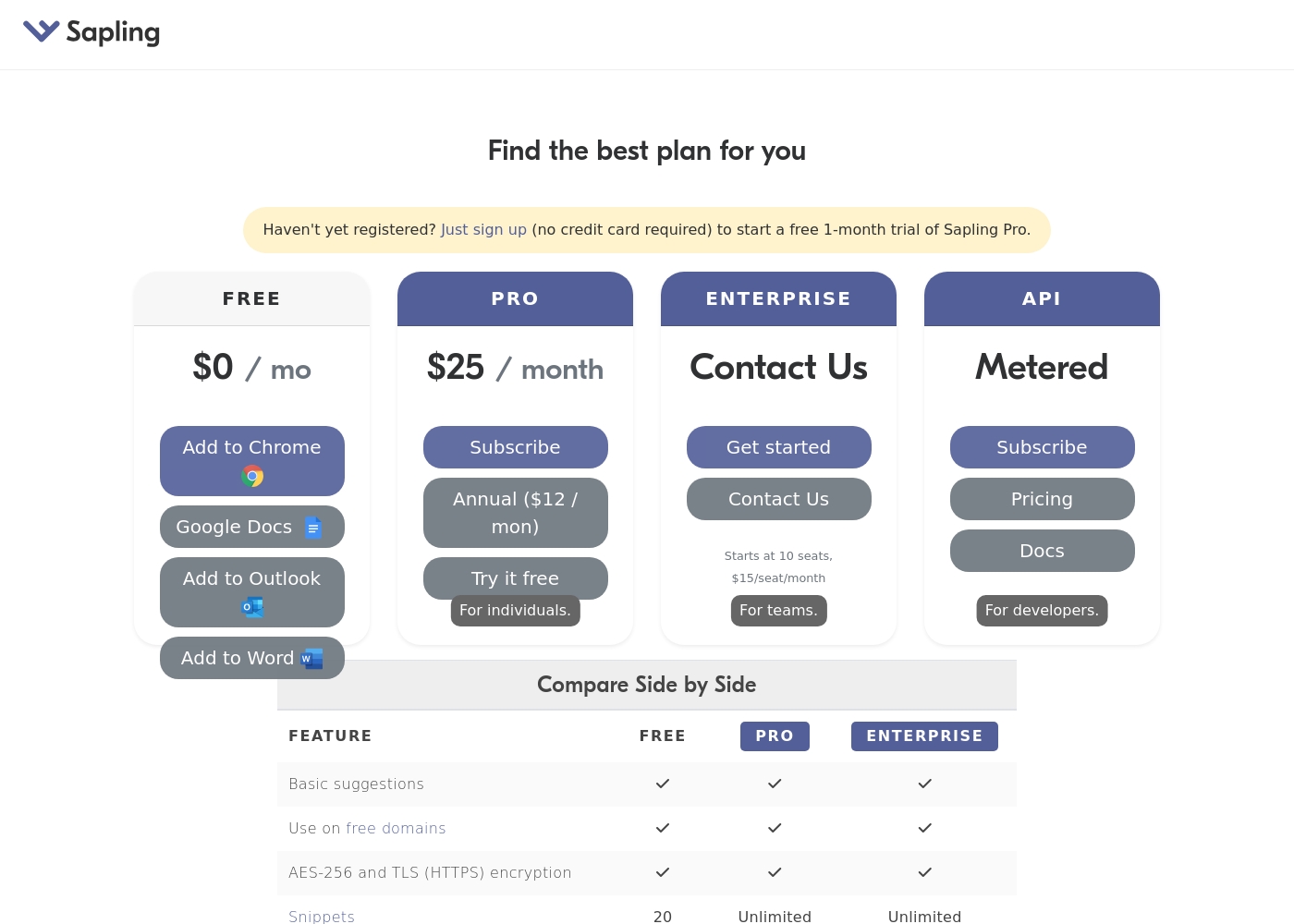
Sapling costs between $0 and $25 per month with four plans: Free at $0/month, Pro at $12/month (annual rate), Enterprise, and API.
You can compare the different options below to find the best fit for your precise writing needs.
Free
Price: $0 / month Best For: Basic individual use Other Features:
- Basic suggestions
- Use on free domains
- AES-256 and TLS (HTTPS) encryption
- 20 Snippets
- Basic suggestions
- Use on free domains
- AES-256 and TLS (HTTPS) encryption
- Basic suggestions
- Use on free domains
- AES-256 and TLS (HTTPS) encryption
- Unlimited Snippets
- Starts at 10 seats
- Priced at $15/seat/month
- Unlimited Snippets
- Basic suggestions and security features included
- Metered pricing structure
- For developers
- Access to full documentation
Pricing Notes
- Pangram Labs' pricing is credit-based. One credit equals one scan for documents under 1,000 words.
- Sapling's annual Pro plan ($12/month) is significantly cheaper than its monthly rate ($25/month).
- Pangram Labs offers a 7-day free trial. Sapling offers a more generous 30-day free trial without a credit card.
- Both offer free plans with limitations: Pangram Labs limits to 4 checks/day, Sapling limits to 2,000 characters per query.
- Enterprise pricing for both requires contacting sales. Pangram Labs emphasizes institutional use; Sapling uses per-seat pricing starting at 10 seats.
Pricing Head-to-Head
User Reviews
External review sentiment for Pangram Labs is currently unavailable. The Trustpilot page returned a verification error, preventing us from accessing user reviews.
Capterra also provided no data. Consequently, this summary reflects only the features and pricing information from the company's own website, which highlights high accuracy, strong integrations, and flexible plans.
Sapling's AI Detector generates starkly contrasting feedback across external platforms, resulting in an overall poor rating on Trustpilot, largely due to major concerns regarding its accuracy. Several users report extreme false positives, where 100% human-written content was flagged as AI-generated 🤯.
This recurring reliability issue is a significant pain point for writers and editors. However, the reviews are not entirely negative.
I was a longtime Grammarly user but grew annoyed by missed basic corrections. I switched to Sapling and was pleasantly surprised by the improvement. It’s just much better at catching mistakes and suggesting concise edits that refine my messaging.
Our Verdict
Let's cut to the chase: for pure AI detection, Pangram Labs is the clear winner. For everything else writing-related, Sapling has its charms.\n\nPangram Labs is a laser-focused tool. Its superpower is unshakeable accuracy, backed by university studies. It integrates where educators work and doesn't try to be anything else.\n\nSapling's superpower is being a helpful writing buddy. It catches grammatical errors and tightens prose. Its browser extension makes proofreading effortless across the web.\n\nThe deciding factor is your primary goal. If you need to make a definitive judgment on whether text is AI-generated, you need Pangram Labs' proven reliability. If you just want better writing with a side of AI checking, Sapling works.\n\nChoose Pangram Labs if you're an educator, publisher, or anyone for whom false accusations have serious consequences. Choose Sapling if you're a solo creator who values writing suggestions and doesn't mind less reliable detection. For high-stakes verification, trust the science. For everyday writing, trust the tool that makes your work shine.
Frequently Asked Questions
Which is more accurate for detecting AI: Pangram Labs or Sapling?
Pangram Labs claims 99.98% accuracy, independently verified by universities. Sapling claims 97%+ accuracy. However, user reviews for Sapling frequently mention false positives, where human text is flagged as AI. For proven reliability, Pangram Labs has the stronger claim.
Can I use Sapling to check for plagiarism like Pangram Labs?
No. Pangram Labs combines AI detection with a comprehensive plagiarism checker in one tool. Sapling is primarily a writing assistant with an AI detector; it does not include plagiarism checking features.
Is Sapling's 30-day free trial really free?
Yes, according to Sapling's FAQ, the 30-day Pro trial does not require a credit card. You can use the full features of the Pro plan, including unlimited Snippets, without entering payment details.
Which tool is better for teachers and schools?
Pangram Labs is designed for education. It integrates directly with LMS platforms like Canvas and Google Classroom, offers institutional licenses, and has verified accuracy for academic integrity. Sapling is better suited for individual writers.
Does Sapling's writing assistant work better than Grammarly?
Some user reviews on Trustpilot praise Sapling's suggestions as superior to Grammarly for catching errors and improving conciseness. However, its AI detector is widely criticized. It's a better writing tool than detection tool.
What's the biggest difference in their pricing?
Pangram Labs uses a credit-based system ($0-$65/month). Sapling's Pro plan is $25/month but drops to $12/month if you pay annually. Pangram offers a 7-day trial; Sapling offers a 30-day trial without a credit card.
Ready to Choose?
Both tools have their strengths. Choose based on your specific needs.